Gravid Mosquito Traps: How They Help Us Detect West Nile Virus in Jackson County
Across Jackson County, our team uses a variety of mosquito traps to understand what species are active and whether they’re carrying diseases like West Nile virus. One of the most important tools in urban and suburban areas is the gravid trap.
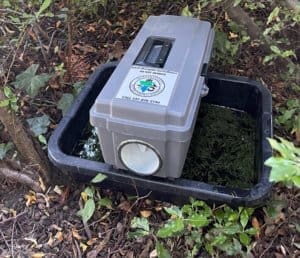
What is a gravid trap?
Gravid traps are designed to attract female mosquitoes that have already taken a blood meal and are ready to lay eggs. These “gravid” mosquitoes are especially important to monitor because they are more likely to be infected with diseases such as West Nile virus.
To lure them in, the trap uses water mixed with organic material—things like hay, grass, leaves, or yeast. As the material breaks down, it creates an odor that signals to mosquitoes: “This is a good place to lay eggs!”
Why gravid traps matter
This trap is particularly effective at catching Culex pipiens, the mosquito species most responsible for spreading West Nile virus in our region. By focusing on mosquitoes that have already fed, we increase the chance of detecting the virus early and responding quickly.
Larval Surveillance: Finding Mosquitoes Before They Bite
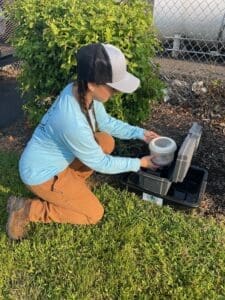
In addition to trapping adult mosquitoes, our trained field technicians inspect hundreds of known and potential mosquito sources every year. Using what’s known as a “dipper cup”, technicians determine:
- The mosquito life stage(s) that are present in an area
- The average number of larvae and/or pupae per dip
- Whether a sample should be collected and reared in our lab for species identification
Understanding which species are present—and how many—helps us decide what, if any, control actions are needed.
Disease Surveillance in Jackson County
All season long, JCVCD tests mosquito pools for West Nile virus, Western equine encephalitis, and St. Louis encephalitis using real‑time RT‑PCR. While we collect many mosquito species, our disease surveillance focuses on Culex mosquitoes, the primary vectors of West Nile virus.
This multi-faceted approach—adult mosquito trapping, larval monitoring, and laboratory testing—helps us stay ahead of mosquito‑borne disease risks and protect the health of our community.
Board of Trustees Places Local Option Levy on the November 2026 Ballot
The Jackson County Vector Control District Board of Trustees — Craig Hility, Mike Taylor, Bruce Jackson, Cal Lanfear, and Robin Norris — has voted to place a local option levy on the November 2026 ballot.
The District requires additional funding to respond to increased demands for service and the rising costs to provide them. The proposed levy is $0.05 per $1,000 of assessed property value (about $1.25 per month / $15 per year for the average property owner).
To learn more, click here: Local Option Levy