What Is an EVS Trap?
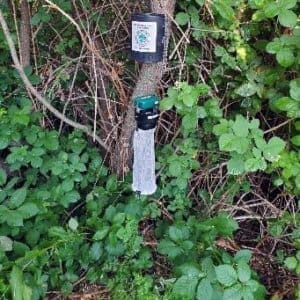
Our EVS traps are one of the most important tools we use to understand mosquito activity across the county. They’re designed to attract host‑seeking female mosquitoes using CO₂ gas released from dry ice — the same signal mosquitoes use to find people and animals.
Once activated, these traps quietly collect a wide variety of mosquitoes, including:
- Nuisance species like Aedes sierrensis and Aedes vexans
- Primary disease vectors like Culex pipiens and Culex tarsalis
These are the species we pay closest attention to because they’re capable of spreading diseases like West Nile virus.
Why We Set These Traps
EVA traps help us answer the big questions:
- Where are mosquitoes active right now?
- Which species are present?
- Are disease‑carrying mosquitoes increasing in certain areas?
- Do we need to take action to protect residents?
This surveillance allows us to respond early, target treatments effectively, and keep the community informed.
What Happens After We Collect the Mosquitoes
Once the trap is retrieved, the real detective work begins.
1. Species Identification
Our trained field technicians sort and identify the mosquitoes by species. This helps us understand which areas have higher numbers of nuisance mosquitoes versus disease‑vector species.
2. Disease Testing
Mosquitoes are grouped into “pools” and tested in our lab using real‑time RT‑PCR, a highly sensitive method that detects viruses such as:
- West Nile virus (WNV)
- Western equine encephalitis (WEE)
- St. Louis Encephalitis Virus (SLEV)
Our disease surveillance program focuses heavily on the Culex genus — the mosquitoes most likely to spread these viruses.
How This Fits Into the Bigger Picture
EVS traps are just one part of our countywide surveillance program.
Every year, our technicians inspect hundreds of known and potential mosquito sources using standard dipping techniques to look for larvae and pupae. If immature mosquitoes are found, we record:
- The stage of development (instar)
- The average number of larvae per dip
- The species, once reared and identified in our lab
Knowing what species are developing — and how quickly — helps us decide whether treatment is needed and what method will be most effective.
Why This Matters for You
All of this work — from EVS traps to larval sampling to lab testing — helps us:
- Reduce mosquito populations
- Detect disease early
- Protect public health
- Keep outdoor spaces more enjoyable for everyone
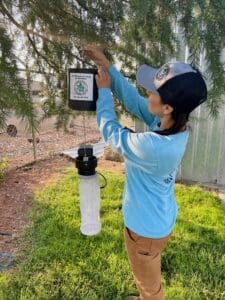
So if you see one of our EVS traps out in the field, you’re looking at a key part of Jackson County’s mosquito defense system in action.
To learn more about Jackson County Vector Control — including what we do, the traps we use, and how we protect public health visit us at jcvcd.gov