
Jackson County Vector Control District will begin countywide adult mosquito surveillance on May 5th, using the full range of traps featured in our public information materials.
These traps help us understand mosquito abundance, species distribution, and potential disease risks throughout the season. Surveillance runs weekly from May through October, with approximately 50 fixed trap locations and additional “floater” traps placed where activity is suspected.
What Traps We Use Across the County
Our surveillance program relies on four primary trap types, each designed to target different mosquito behaviors and species:
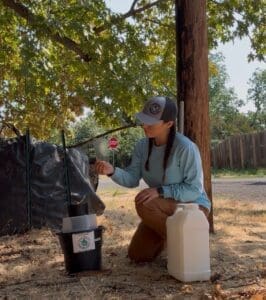
• Encephalitis Virus Surveillance (EVS) Traps — Use CO₂ from dry ice to attract host‑seeking female mosquitoes, including nuisance species like Aedes sierrensis and Aedes vexans, as well as disease‑vectoring Culex pipiens and Culex tarsalis.
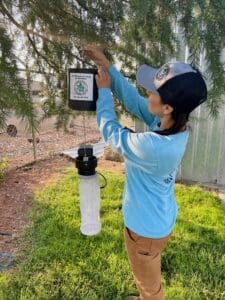
• Biogents Sentinel (BG‑Sentinel) Traps — Use CO₂ and a synthetic human‑scent lure to attract a wide variety of mosquitoes depending on the lure combination.
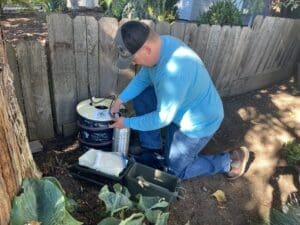
• Gravid Traps — Use organically infused water to attract egg‑laying female mosquitoes, especially Culex pipiens, which are more likely to carry diseases after taking a blood meal.
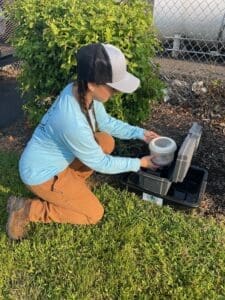
• Biogents Gravid Aedes Traps (BG‑GAT) — Designed to detect invasive species such as Aedes aegypti and Aedes albopictus, which prefer to lay eggs in small containers around homes. These traps use water and sticky cards to capture mosquitoes.
Why Trapping Matters
• Tracks mosquito populations and species changes across the county
• Helps identify areas where disease‑vectoring mosquitoes are active
• Supports early detection of West Nile virus and other pathogens
• Guides targeted, environmentally responsible mosquito control efforts
This surveillance is a core part of how we protect public health and keep mosquito populations below nuisance levels.