• Skip to primary navigation
  • Skip to main content
  • Skip to primary sidebar
Contact Us
  • Submit a Service Request
  • [email protected]
  • (541) 826-2199
JCVCD Logo
Main Menu
  • Home
  • Planned Control
    • Notification List
  • Mosquitoes
    • Submit a Service Request
    • Aedes aegypti Mosquito
    • Surveillance
    • Dead Bird Testing
    • Mosquito Control
    • Application Updates
    • Mosquitofish
    • Mosquito-Borne Illness
    • Mosquito Prevention Tips
  • Flies
  • Rats
  • Ticks
    • #dontbeaticktarget
    • Tick Life Cycle
    • Tick Identification
    • Tick Sampling and Disease Surveillance
    • Tick-Borne Diseases
  • News
    • JCVCD In the News
    • Press Releases
  • About
    • Staff and Board
    • Resources
    • Products We Use
    • Public Meeting Notice
    • Job Opportunities
  • Contact
    • Location
    • Service Request
    • No Spray
    • Notification List

Public Meeting Notice:

    Tick Life Cycle

    Most ticks go through four life stages: egg, larva, nymph, and adult.  Ticks must take a blood meal at each life stage to survive to adulthood.  Some species use a single host for all life stages while others, like our local species, will use a different host at each life stage.  These types of ticks are known as “3 host ticks”.
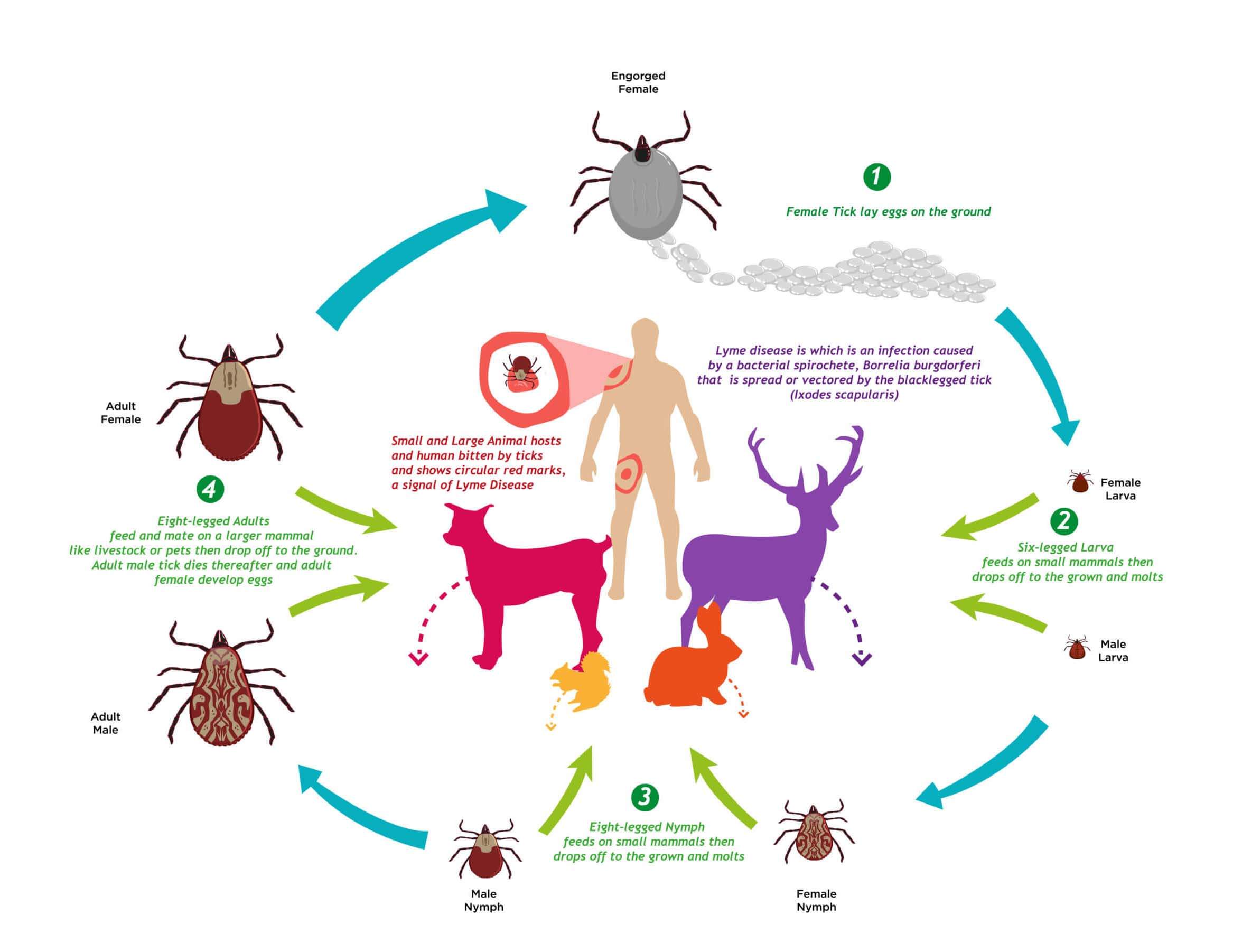
    To find hosts, ticks wait on the tips of grasses and vegetation with their forelegs extended.  This behavior is known as “questing”.  Ticks detect body odors, heat, moisture, and vibrations of passing animals and latch on when a host brushes by.  Once a tick attaches to a host, it will usually start feeding within a few hours.  The tick will puncture the skin with its hypostome, or feeding tube, and suck blood slowly for a few days.  Many ticks secrete a concrete-like substance through their mouthparts that helps them stay attached during feeding.  A tick’s saliva also has chemical compounds that act as an anesthetic during feeding.  This helps prevent the host from feeling the bite and better enable the tick to feed for longer periods.  If the tick is carrying a pathogen, that pathogen can be transmitted to the host through the saliva of the tick as it feeds.

    sidebar

    Share on Facebook
    Facebook
    𝕏 Share on X
    X
    Share on Linkedin
    Linkedin
    Share on Email
    Email
    JCVCD Logo

    CONTACT US

    Jackson County Vector Control District
    555 Mosquito Lane, Central Point, OR 97502

    Call Us
    (541) 826-2199

    Email Us
    [email protected]

    FOLLOW US

    Like us on
    FACEBOOK

    Follow us on
    YOUTUBE

    HELPFUL LINKS

    • Submit a Service Request
    • No Spray List Request
    • Adult Mosquito Control Application
    • Public Meeting Notice
    • Board of Trustees Records
    • Budget Committee & Budget Hearing Records
    • Contact Us

    PUBLIC MEETING NOTICE

      © 1968 - 2026 Jackson County Vector Control District
      Servicing Jackson County, Oregon.